Groove Theory #19 - Three Sets of Spiders and a Purple Foam Hand
Not yet a subscriber? Sign up. Or explore the Groove Theory archive →
I'm your host, Howard Gray, founder of Wavetable - the experiential education studio.
Currently: preparing for a big keynote in Paris on AI Acceleration; launching a browser-based game set in outer space; uncertain about which biscuit goes best with a cup of tea
I took a turn around Hackney Wick last week. Down the canal, past the park, and then - almost by accident - the Olympic stadium.

Somehow it’s been fourteen years since that halcyon summer of London 2012. But my persisting memory isn’t of Usain Bolt, or beers at sunset, or that it was probably the last time London was genuinely great (hate mail incoming…).
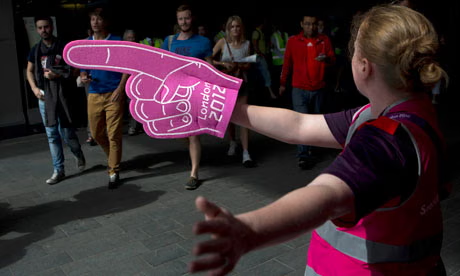
Instead, I keep thinking about a purple foam hand.
The games had very little budget for digital signage. No way to manage tens of thousands of spectators exiting through a bottleneck to a tube station that couldn't cope.
The modelling showed catastrophic queues. The budget showed nothing left. Something had to give.
So Heather McGill - Head of Spectator Experience, the first time any Olympics had someone in that role - gave the “Games Makers” volunteers giant purple foam fingers. Not as wayfinding devices. As... toys.
And she gave the Games Makers no scripts. Just permission: do YMCA, do high fives, make people laugh.
When researchers asked people afterwards how long they'd waited, they reported 50% less time than the actual queue. Same wait. But it felt half as long.
Nobody told the Games Makers what to do with the hands. They just trained them how to be.
The Tension
How do you choreograph emotion for 80,000 strangers without it feeling manufactured?
You can script every moment. Optimise for Instagram (yurgh). But will anyone remember it next week, next month, next year?
The moments that stay with us are different - the collective intake of breath, the giggle after the scream.
Tricky bit is, you can't direct people into those. You can only design the conditions for them to become unavoidable.
Step Into It
You're running a 200-person full-day event. It's 2pm. The energy is flagging. Do you stick to the run sheet or trust your facilitators to improvise?
Option A: Stick to the run of show. Hit your marks. Stay controlled.
Option B: Trust your team to read the room. Accept that some moments will go sideways.
Which are you designing for?
(I have taken both options, fwiw)
The Groove: Rhythm
The pacing and timing that keeps audiences engaged from start to finish
Heather went from Spice Girls tour producer to London 2012 to inventing the Harry Potter Forbidden Forest Experience.
She talks about experience beats the way a DJ talks about beats in a set. You plot your peaks (in her case - fire, water, shock). But the lulls matter more.
"The downs are almost more important than the ups," she says. "You have to let the audience breathe."
Which brings us to the spiders.
In the Harry Potter experience, guests enter Aragog's lair. Lighting draws your eyes forward. Then the first batch of spiders drops from above. Screams. You look up.
The second batch drops. You're oriented. "Okay. This is great."
Third batch - when everyone thinks it's over. The rig drops fast, closer than anyone expected.
"That's where people really scream," Heather says. "My favourite thing was to stand outside and hear people scream - and then giggle."
First drop: surprise. Second drop: recognition. Third drop: anticipation becomes participation.
That's not repetition. That's rhythm.
There's something here I keep bumping into. The instinct is to tighten - more scripts, more control, more certainty. But the magic seems to live in the opposite direction. Yet go too far, and the rhythm falls away.
1. Make them think it was their idea.
The manager from Victoria tube station walked into a design workshop looking disgusted. (There were dogs present.) He left feeling like he'd designed part of the games. That ownership carried London 2012 through. I also received this same 'make them think it's their idea' advice when I worked at ad agency re. dealing with clients. It was not incorrect.
2. Autonomy scales better than scripts.
You can't pre-write 70,000 volunteer interactions. But you can train a disposition. Heather's team didn't give the Games Makers a manual. They gave them permission - to step outside their role, express themselves, have fun. The foam finger was just a prop. The real tool was freedom.
"We are all brilliant at this," Heather says. "We're all customers. By midday on any given day, you've probably been a customer six times. You already know what great service feels like." All you have to do is get that out of people and apply it to something slightly different.
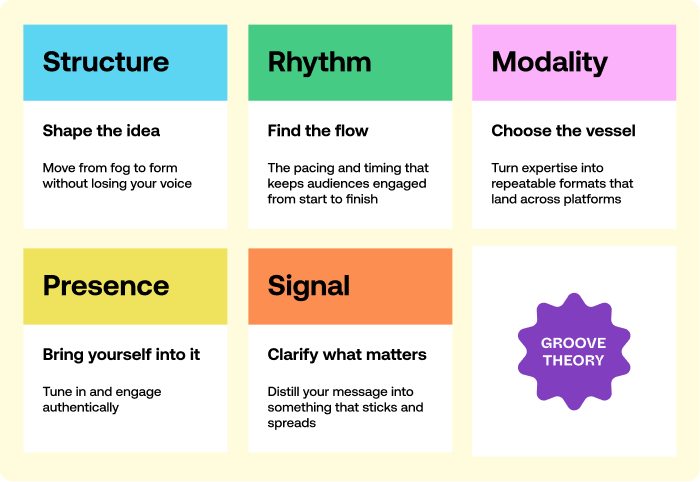
Rhythm is one of the five elements of Groove Theory.
The Release
There's a moment Heather keeps coming back to. Early in her career, working on a Roger Waters tour. The Wall.
The lights change. One chord plays.
The audience already knows what's coming - they've heard it a hundred times before. But the eruption when that chord hits...
"It was everybody in that moment doing that thing," she says. "You couldn't be anywhere else but in that arena to experience it."
That's what she's chasing. Not the thing you're designing - the shared experience around the thing.
She puts it better than I could: "You're not celebrating the sandcastle. You're celebrating that you built it together."
So maybe the question isn't whether we can script a better experience. It's whether - painful as it can be - we're willing to design for the moments we can't control.
Howard
Extended Mix
- The Disney trick: Disney parks have a bandstand blocking your sightline until you've moved past the entrance. It prevents backlogs of people taking photos. London 2012 used the same principle - a decorative gantry blocking the stadium view until people crossed the bridge.
- On constraints: "I prefer working with constraint," Heather says. When someone in Dubai told her to "imagine whatever you want"... her brain went blank. Turns out "anything" is harder than "something.”
- Blurring Radio: unrelated, but I had to share. The latest music selection from indie book publisher Blurring Books and their founder DB Burkeman is magnificent. Where they find the deeper cuts, I have no idea. But I’m glad to have them in my ears.
Member discussion