The Feral Hope
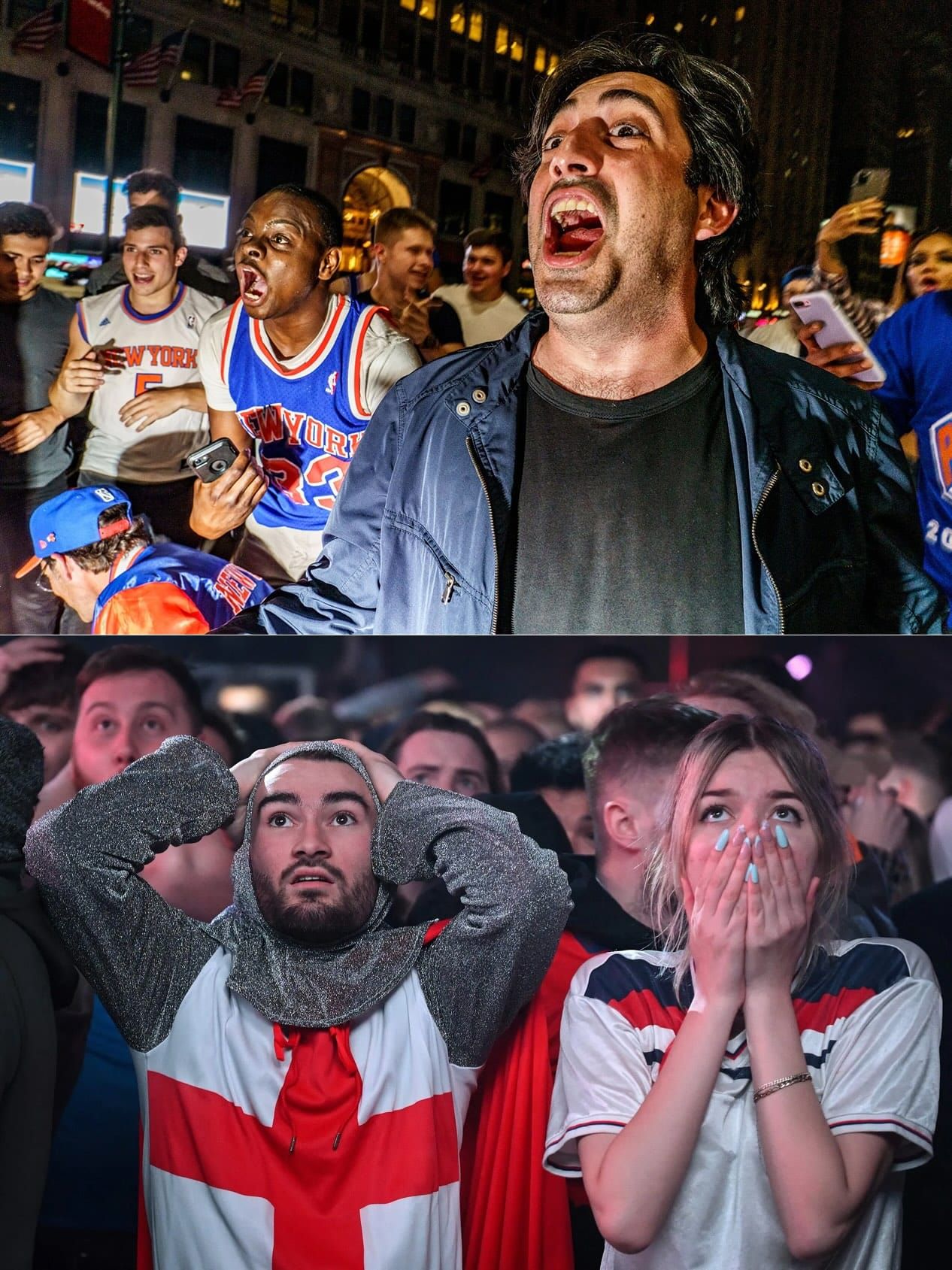
Last summer. A grimy bar on NYC's Lower East Side. Knicks versus Celtics, an NBA playoff game. I'm there with my friend who - inexplicably, given where we are - supports Boston.
She is the only Celtics fan in the room. She knows this.
The Knicks go up big. The bar gets loud. Not quite happy loud - more feral loud. Then Boston pegs them back. The room tightens up - like the East Village and Two Bridges are squeezing the LES from either side. There's muttering. Pacing. A guy at the end of the bar puts his head in his hands like he's receiving bad medical news. Another digs his claws into his friend's shoulder while his eyes stay fixed on the screen.
Then the Knicks pull ahead again.
My friend is looking nervous. Not because of the game - because of where we are. She's surrounded by people who are experiencing something closer to fever than fandom.
I watched this unfold and thought: I know this energy. It's has a different scent, a broader accent, but I know it. I grew up with it.
Same tribe, different accents
I'm English. Which means I've spent my whole life watching my national soccer (y'know, football) team find new and creative ways to not win tournaments. As I write this, the World Cup has just kicked off. As a transatlantic transplant it feels a little peculiar - I'll be in London for the group stages, NYC for some of the knockouts, then London again.
And last week it occurred to me. Seeing the reactions from this year's NBA finals game 3, thinking back to that Lower East Side bar last summer, sensing the atmosphere around England's upcoming campaign.
It occurred to me that Knicks fans and England supporters might not just be similar. They might be the same tribe.
Not in the details - obviously. But in the emotional contours. The way hope comes out sideways, disguised as aggression. The superstitions. The suspicion when things go well. The way decades of almost-winning has curdled into something that looks, from the outside, a bit unhinged.
Both fanbases appear to be feral in a way that other fanbases aren't. Lakers fans expect to win. Patriots fans got used to winning. Knicks fans and England supporters expect to nearly win - and have developed an entire emotional architecture around that experience.
The parallels
Different sports, different continents, and different types of place (one is a country, the other may well believe it is a country - I'll let you decide which is which).
And yet, once I started listing the parallels, I couldn't stop:
| Knicks | England | |
|---|---|---|
| Originators who feel owed | MSG is "the Mecca" | "We invented football" |
| Decades of hurt | 53 years without a title | 60 years since '66 |
| Suspicious of hope | Nervous when up by 12 | Nervous when up 2-0 |
| Demanding, not grateful | Boo their own players | Turn on managers mid-tournament |
| Angry at the institution | Dolan, the Isiah years | The FA, "the blazers" |
| Working class DNA | Oakley, Ewing, bruiser ball | Terrace culture, away days |
| Confrontational | Spike jawing at Reggie | Too many hooligan incidents to mention, frankly |
| Masochistic pride | "I survived the Isiah years" | "30 years of hurt" as anthem |
| Joy comes out as aggression | Storming Seventh Avenue | Storming Boxpark |
| Irony as armour | Riot jokes before Game 3 | "It's Coming Home" (knowing it won't) |
Why, though?
I started wondering what actually connects them. Why these two fanbases, specifically?
Part of it is the obvious stuff. Both cities - New York, England's football heartlands - are dense, urban, industrial. The sports grew from the same soil: working class, street-level, the people's game. Not golf. Not tennis. Something you could play in a cage or on concrete.
But there's something deeper.
Entering the Orbit
Both places carry the weight of having been the core, the centre, the claim to be the original. England had an empire. New York had - c'mon, still has - the conviction that it's the capital of everything. When you believe you're the original, the source, losing isn't just disappointing. It's an insult. A cosmic error that needs correcting.
And maybe there's something in the immigration patterns, too.
In 1948, a ship called the Empire Windrush brought Caribbean migrants to England - many settling in South London. Their children and grandchildren reshaped English football. Viv Anderson. Ian Wright. Raheem Sterling. Marcus Rashford. Bukayo Saka.
Around the same time, Caribbean communities were putting down roots in Brooklyn and the Bronx. Patrick Ewing arrived from Jamaica in 1975. This season's Knicks roster includes Karl-Anthony Towns (Dominican) and Jose Alvarado (Puerto Rican, Brooklyn-born).
Before the Caribbean waves, it was Irish, Jewish, Italian. In 1946, the Knicks fielded six Jewish players. Basketball was the city game - a working class path out. English football grew the same way: factory towns, terraces, something to believe in when the week was brutal.
The tribalism forged in tight spaces. There's a loyalty that borders on religious -just with different accents. Same desperate need for the team to mean something beyond the score.
Both fanbases have been shaped by almost-winning. Not losing - almost-winning. There's an important difference.
Almost-winning is getting to the door. Seeing it open. Watching it close. Sometimes it stubs your toe.
That's what makes the hope so feral. It's not naive. It's wounded. It's been here before.
The Knicks were in the Finals this past week. New York erupted when they clinched it for the first time in over 50 years. As I write, England are tuning up for their first World Cup match. Their fans watch with the same nervous energy, the same rituals, the same refusal to say "when" instead of "if."
Two tribes, one affliction.
Last week, strangers hugged on Seventh Avenue. Grown men cried on the subway.
Two weeks before in North London, Arsenal fans did the same thing - estimates had over 1m people attending their Premier League victory parade.
Sport doesn't need translating. The nervous is the same. The release is the same. And for a few minutes, people who have nothing in common have everything in common.
It's coming home. (Inevitably, it won't.)
But what if it did? Because if the Knicks can...

Member discussion