The Fortune Cookie Test
If your feedback would fit anyone, it's a fortune cookie.
“You showed good judgement here” fits everybody.
That's one of six rules. Fer, our Experience Design lead, spent a few weeks in the research on feedback - what changes behaviour, what just makes people feel judged.
We needed them because we're working out how a simulation should respond to a player while they're still playing, rather than at the end in a report.
The other five:
- We comment on how someone decided, not what they decided, and never on who they are.
- We reframe rather than evaluate - same facts, a different lens.
- We stay tentative, because the player should need us less afterwards, not more.
- We don't give scores. Attach a number and people read the number and ignore everything else.
- Every piece of feedback ends with one thing to try tomorrow.
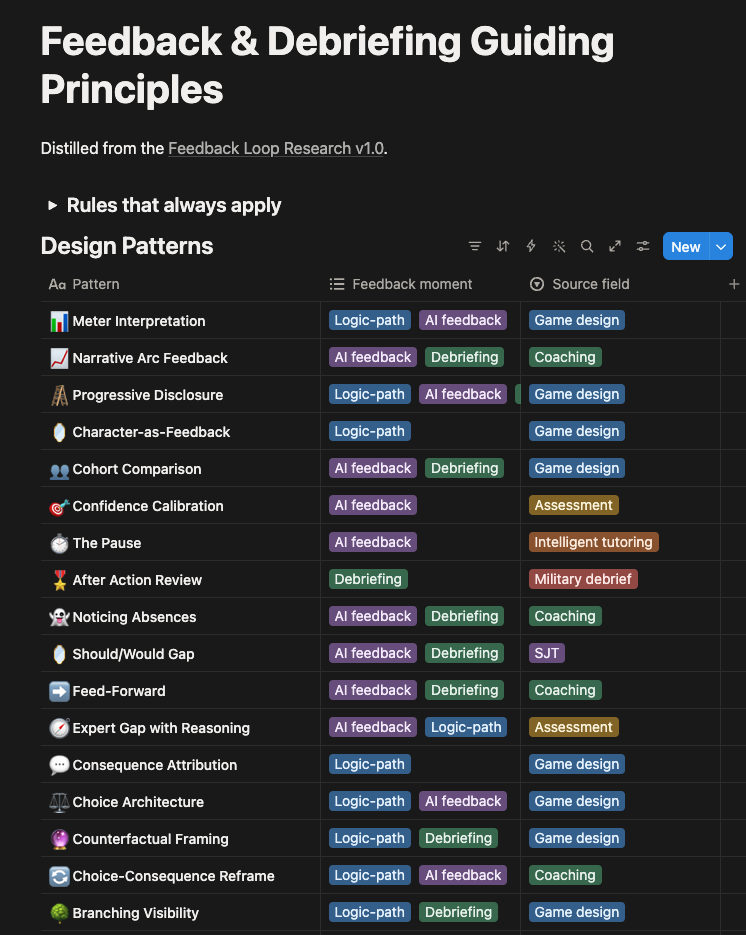
Under the rules sit sixteen design patterns, each tagged with where it came from. Some are game design. Some are coaching. One is a military after-action review.
Which pattern belongs to which moment is the properly difficult part. What works after a two-minute drill doesn't work after a long scenario.
We're still working that out.
Member discussion