Groove Theory #30: Barrilete Cósmico
I'm your host, Howard Gray - founder of Wavetable.
Currently: getting more bookings to speak about AI (it’s always nice to be wanted); wondering if England will play Argentina this week…
Mexico City, 1986. Diego Maradona picks up the ball in his own half and runs through the entire England defence. Goal of the Century.
In Buenos Aires, radio commentator Victor Hugo Morales loses his mind.
“Genio… genio… genio… ta ta ta ta ta…”
He screams. He stutters. He invents a phrase on the spot - “Barrilete cósmico” - cosmic kite.
“Thank you, God, for football, for Maradona, for these tears.”
In Argentina, the riff became as famous as the goal itself. Museums play it on loop. Documentaries treat it as cultural artifact. When Morales dies, someone will play it at his funeral.
But for years, he couldn’t listen to it.
The Tension
A professional commentator - trained, prepared, experienced - reduced to fragments and tears. Stuttering "genio, genio, genio" like something had short-circuited. Inventing phrases on the spot. Thanking God on air.
In a 2011 interview, Morales admitted he was ashamed of it. He'd lost himself completely - and for a long time, that felt like failure.
I get it. Most of us are conditioned to stay composed - to be the expert who stands just a little bit away from the moment, not the person swept up in it. Losing control feels unprofessional. The cringe comes later, replaying it in your head (usually at 2am, inevitably).
But Morales did something that day that all his composed commentary never did. People don't just replay the goal - they replay the commentary with it. His loss of control became part of what they want to feel again.
Step Into It
There's a language you're supposed to use - the professional version, the one that sounds like you know what you're doing. And then there's the thing you actually wanted to say.
When did you last let yourself get genuinely excited about something out loud?
Not the measured version. Not the one that sounds credible in the meeting. The one that came out before you could edit it.
If you've ever facilitated a workshop, led a meeting, or reacted publicly to someone else's work - you've been in the commentator's booth. The question is the same: how much of yourself do you let in?
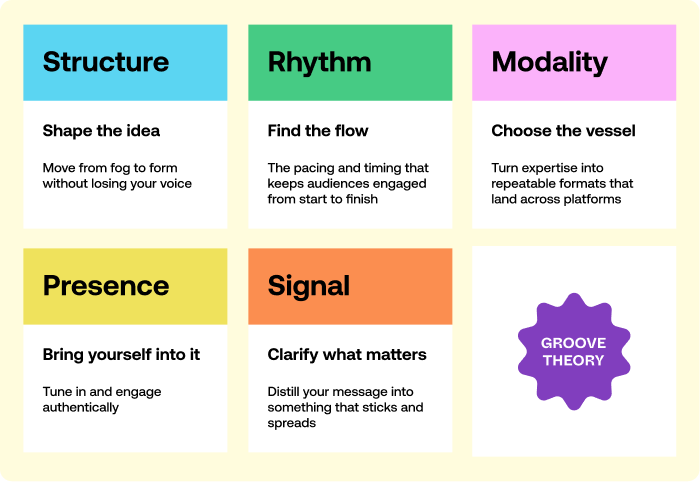
The Groove: Presence
Different cultures navigate this tension differently.
English commentary leans clinical. Veteran commentator Clive Tyldesley: "Commentary is the soundtrack. Nobody ever goes to the cinema to listen to the soundtrack." The commentator as professional observer - present but separate.
Arabic commentary goes the other direction entirely.
Balagha (البلاغة) is classical Arabic rhetoric dating to pre-Islamic Arabia. The word derives from "to reach" or "to convey successfully." Not just persuasion. Reaching the height of eloquence.
Issam Chaouali doing what he does best
Issam Chaouali, the Tunisian voice of beIN Sports whose voice is installed in both Real Madrid and FC Barcelona's club museums: "We're emotional societies. We rejoice deeply and grieve deeply. It's in our nature and in our genes; we have a tendency to overreact, and I'm one of you."
I'm one of you.
Saudi commentator Khalil al-Balushi, when his country beat Argentina at the 2022 World Cup: "Write this in history! Allah, Allah, Allah. Impossible is not a word that exists in the Saudi and Arab dictionary."
The English approach: stay separate, be the soundtrack. The Arabic approach: be the extended arm of the fan. Latin America goes further still - be overcome.
Yet all require the same preparation for presence. Chaouali: "I devote all my time to my work. I look for details and scrutinise them, leaving nothing to chance."
Some find a way to bridge the two. Peter Drury - English, but closest to the emotional tradition - puts it simply: "Sometimes just shouting the right name at the right time does it."
The preparation creates the conditions to be genuinely surprised. You can only lose yourself if you know exactly where you are.
Football - despite its uglier sides (hi, Gianni) - is one of the few things that still lets strangers feel the same thing at the same time. Across languages, across cultures.
1. Know when to shut up
The best commentators go quiet when the action speaks for itself. Tyldesley: "Silences are not rests, they are thinking time." If the thing is working, don't commentate over it. And when technical insight is needed, that's a different mode - the co-commentator. Not every moment needs the same voice.
(This is a tricky skill. I still struggle with discomfort when there's 30 seconds of silence when I'm teaching…)
2. Harq a'saab - burning of nerves
The Arabic phrase for what commentators do: channel tension, not reduce it. Sometimes your role is to amplify what people are already feeling, not calm them down.
3. Feed the well
You can only improvise with what's already in your brain. Commentators who read widely - poetry, history, anything - have more to reach for when the standard words run out. The language that moves us still has to come from somewhere.
The Release
Young Noble - the Nigerian creator behind "Homemade Highlights" - remixes commentary from his bedroom or local football field. But he's not sampling the clinical stuff. He's remixing the moments when commentators lost themselves. The screams, the invented phrases, the ones who forgot they were supposed to stay composed.
That's what millions of people want to hear again.
I love this guy.
Victor Hugo Morales cringed at his recording for years. But nobody's remixing the measured, professional version. No one plays his most composed piece of delivery at his funeral.
I reckon Morales had it backwards. The preparation wasn't wasted when he lost himself - it's what let him lose himself. "Cosmic kite" didn't come from nowhere. It came from decades of fluency.
We're all in the booth sometimes - presenting, explaining, reacting to moments that aren't ours. There's a craft to bringing it alive: following the play, knowing the details, finding the right words. The preparation matters. So does knowing when to let it go.
Howard
P.S. I'm writing this an hour before England kick off their World Cup quarter final against Norway. If they win, chances are their next game is... Argentina.
Extended Mix
- Train the Instrument: Andres Cantor - the Argentine commentator famous for the extended "GOOOOOL" on Telemundo - took voice lessons with Gloria Estefan's coach. The thing you do naturally still benefits from deliberate practice. Here's his pre-World Cup training regime
- The GOOOOOL origin: The extended “gol” dates to 1946 Brazil. Sao Paulo radio announcer Rebello Junior bellowed it until he ran out of breath. It spread from there.
- Arabic tradition in action: Ali Mohamed Ali when Egypt goalkeeper Mostafa Shobeir made a save against NZ: "Shobeir, you lion!"; then as Salah surged forward: "Mohamed Salah, this is your move. This is your moment." Salah scored. Arabic commentary addresses players directly from the booth, speaking to them, not about them.

Member discussion