Groove Theory #31 - Joker Poker
I'm your host, Howard Gray - founder of Wavetable.
Currently: building off-sites that don't feel like off-sites; making Minecraft treasure chests from cardboard.
This week I've been designing three games at the same time.
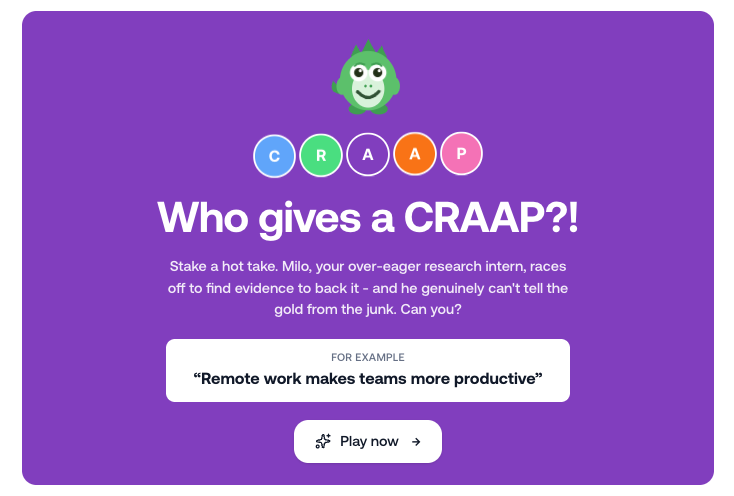
The first is for work - a game for grown-ups, the kind of thing I build for a living. It's a 'Hot Takes' game - you float a provocative idea, an unreliable AI intern digs up evidence to back you up, and then you find out how well the whole thing holds up. The sort of thing a professor sets loose on a class, or a strategy lead on their analysts.
The second game is a birthday party.
My son is turning five. Somewhere between six and twenty-six children will come - I genuinely don't know how many, and neither does he. It's in a public park, so I can't even rely on walls. And he's requested, with total confidence, a Minecraft party.
Except… he doesn’t really want Minecraft. He's four. He doesn't know how it works. Gently push him on it and what he wants is the feeling of it - the pickaxes, the blocks, the creepers, the diamonds. He sees the big kids at school being into Minecraft.
So what should it be, exactly?
After wrangling with it a while, I went away from Minecraft entirely - stopped trying to reproduce the game, made some other stuff. Then, I came back to it sideways, through the parts that matter to a five-year-old: tools, dragons… cupcakes.
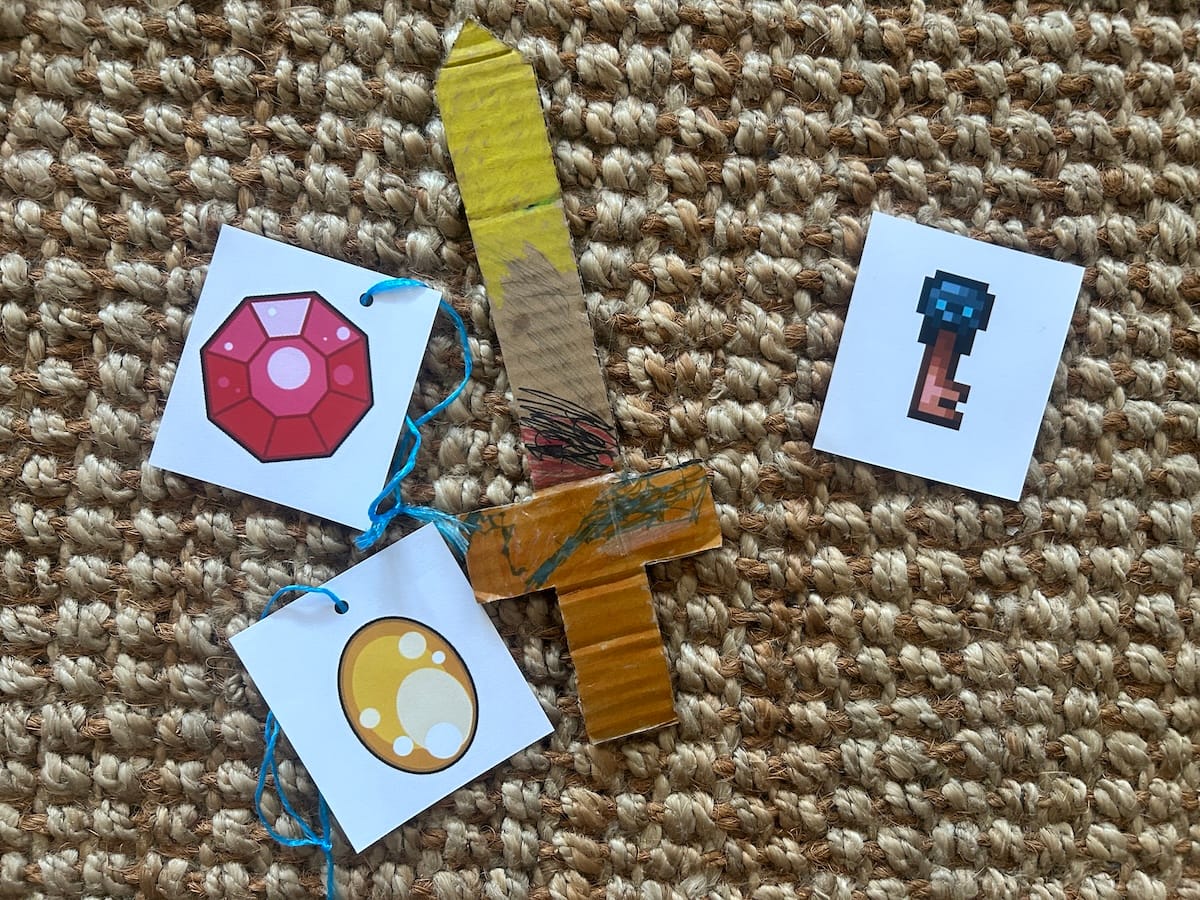
As for the third game - I don't get to write its rules, and alas cupcakes aren’t the unlock. Another story.
Either way, my week has been consumed by three games. None I fully understand. All due sooner than I'd like.
The good news: these constraints are also how one of the most talked-about games of the decade got made.
The Tension
LocalThunk - a pseudonymous games designer - created Balatro, a single-player card game. You build a poker hand, then juice it with oddball 'joker' cards until the score tips into the millions. It's sold more than five million copies and became the first game made by one person ever nominated for Game of the Year.
Picture a bedroom producer, no label behind him, up for Album of the Year against the majors. Sort of like Banksy, or Burial before anyone knew his name - working in 16-bit graphics.
He built most of it refusing to look at anyone else's work.
"I intentionally avoided playing or watching most games outside of Rocket League in an effort to keep my design ideas fresh and keep myself interested in the design space I was naively exploring."
(Rocket League is a game about playing football in rocket-powered cars - not even relevant to his own game…)
Everyone told him to study Slay the Spire, the game his whole genre treats as the masterpiece, the obvious homework. He refused to touch it for a year and a half.
I know that instinct, although I don't always channel it. Once you've seen how someone brilliant solved your problem, you can't unsee it - their answer is just there, and so often you drift towards it without meaning to.
That clumsy, naive early stretch - reinventing wheels, wandering down routes nobody sensible would take - is where the original stuff often comes from. That's what all LocalThunk's not-looking was for.
Step Into It
You're designing something - a strategy, a plan, a pitch. Something with oomph.
The client mentions a famous framework twice. There's a book everyone in your field has read. The professional thing to do is to consume all of it before you start, to arrive fully briefed.
You know how this goes. You watch the author’s talk on YouTube, and a few of its lines lodge in your head. You skim the book, and a fortnight later you're thinking in its categories without noticing.
Sit down to build, and you catch yourself tracing. The lines are already there in someone else's hand; all you're doing is inking over them.
What if the homework you're supposed to do - and the inspiration you go hunting for - is exactly what makes your work sound like everyone else's?
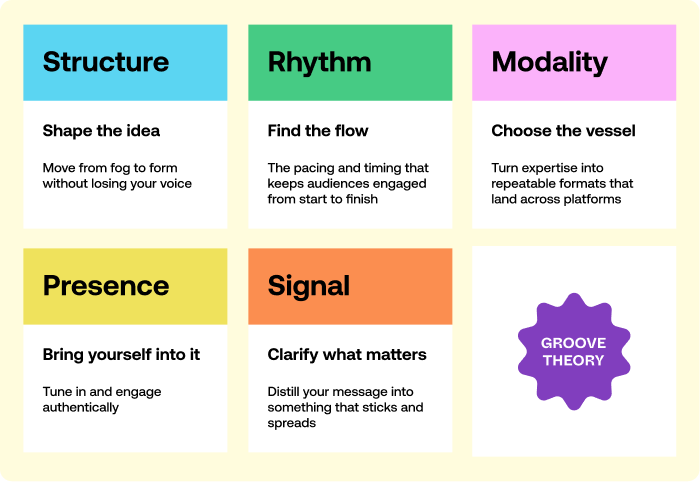
The Groove: Structure
Shape the idea. Move from fog to form without losing your voice.
We usually mean one thing by structure: the shape of the finished thing - the outline, the scaffolding you hang your ideas on. There's a second kind that gets almost no attention - the structure of your inputs. What you let in, and when.
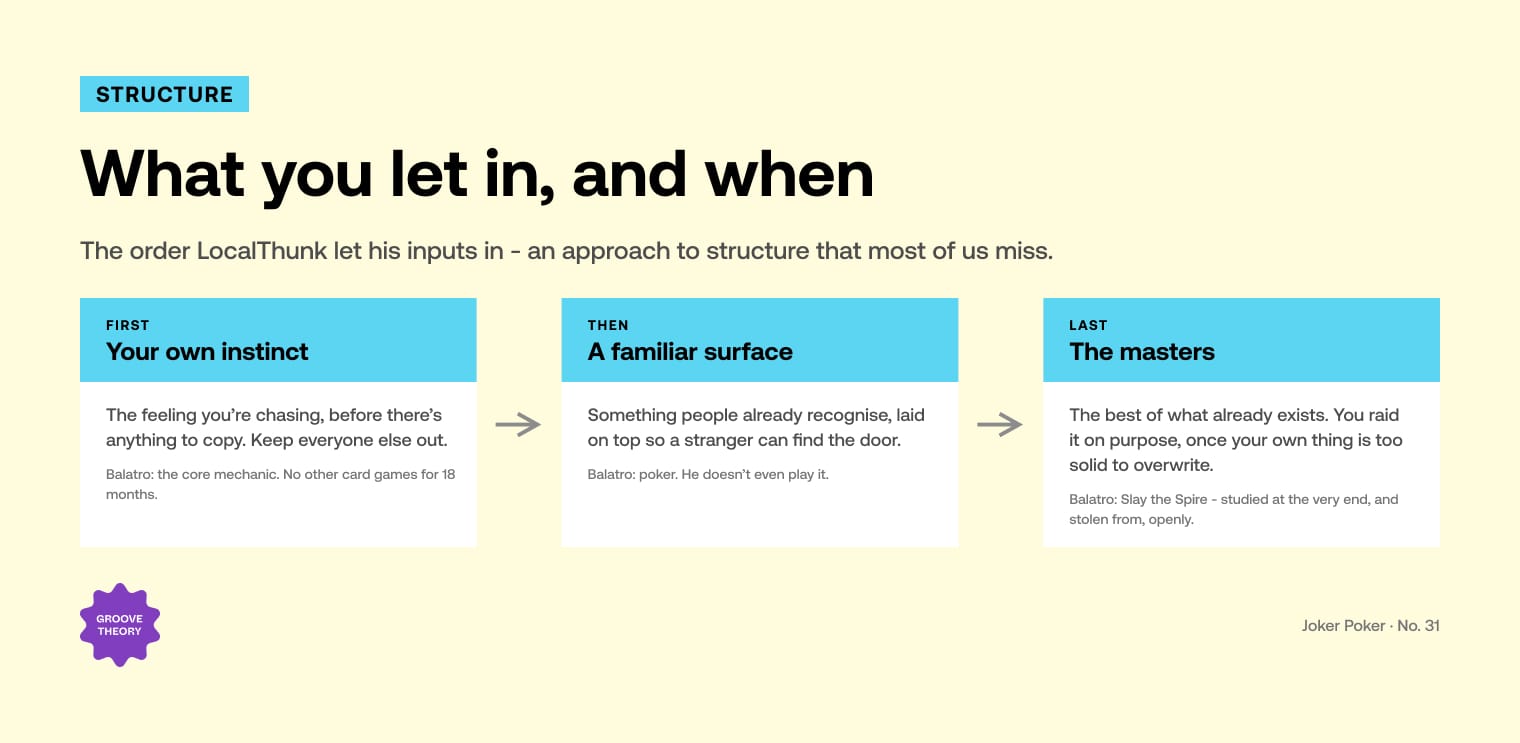
LocalThunk was strict about it. For a year and a half he let almost nothing in - no other card games, nothing from his own genre - and only went looking once his game could absorb the hit.
The first thing he let in was the feeling he was chasing - breaking rules, stacking combinations until the numbers went silly - long before he knew what the game was even about.
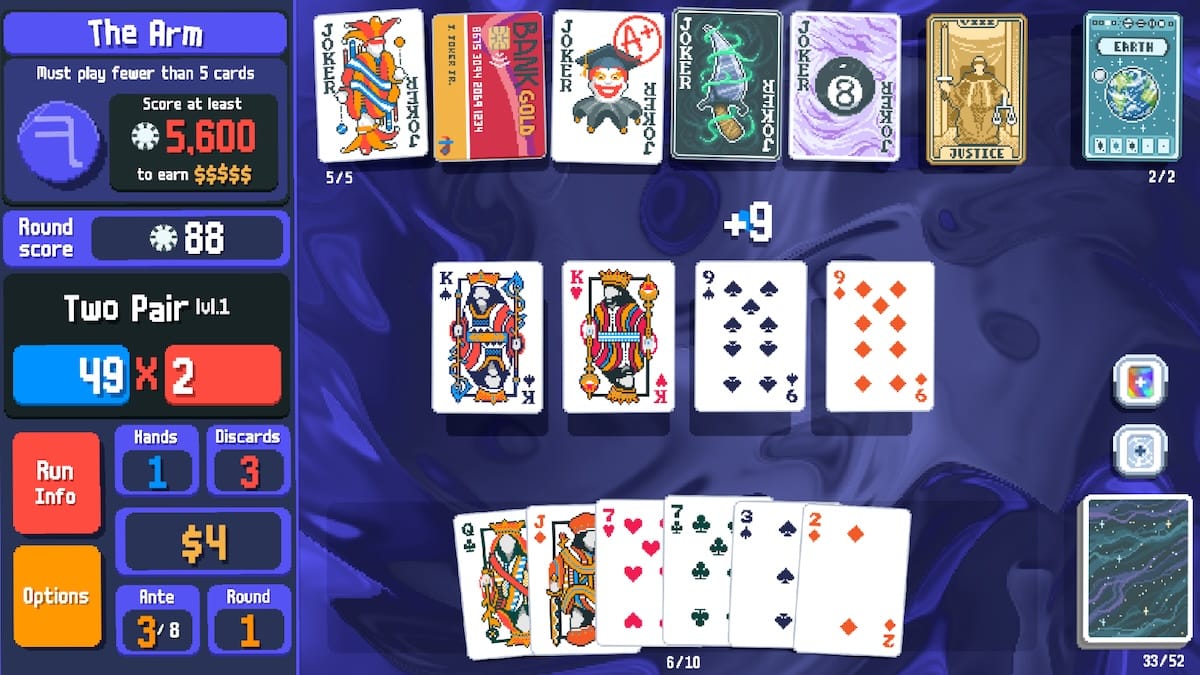
The theme came later, and it barely mattered. Balatro looks like poker on the outside, though LocalThunk doesn't even play it. "The poker theme was slapped on top of the game I was already creating, mainly as an onboarding tool." It's there so a stranger can glance at the screen and feel they already know the rules.
Other people's work came last of all. Only once the game was unmistakably his own did he go looking. A year and a half in, he finally bought Slay the Spire - and only to crack one narrow problem: how you let someone play a card game with a controller instead of a mouse.
His reaction, in his own dev diary: "Holy shit. now that is a game." Then, a beat later: "Thank goodness I avoided playing it until now because I surely would have just copied their incredible design."
Months on, he lifted its difficulty system outright and noted it in his patch log: "This is from Slay the Spire (see? Told you I'd steal from it)."
1. Feel first, measure later
Trust how a thing feels before you make it technically correct. LocalThunk: "If the picture FEELS level but actually isn't, that is better than it being technically level but feeling askew." The spreadsheets came after.
2. One obsessive beats a happy room.
Don't tally the people who quite liked it. Watch for the one who can't put it down. (LocalThunk knew he had something when a friend sank dozens of hours into a rough build.)
3. Do the reading last
Do your own fumbling before you study how anyone else solved the problem. The clumsy first draft is the only one that's fully yours - get it down before you go looking.
The Release
I've got three games in development, and a card-game designer in Canada has shown me how to think about two of them.
I don't need to understand Minecraft. I need the coat of paint - it's not even called a Minecraft party, it's a Block Party. I don't need to understand the grown-ups' game yet either - I need the feeling I'm chasing, and the discipline not to fill my head with everyone else's answers before I've found my own. And because I can't know my numbers - six or twenty-six, a handful of players or a full house - I'm building something loose. A shape that hopefully flexes.
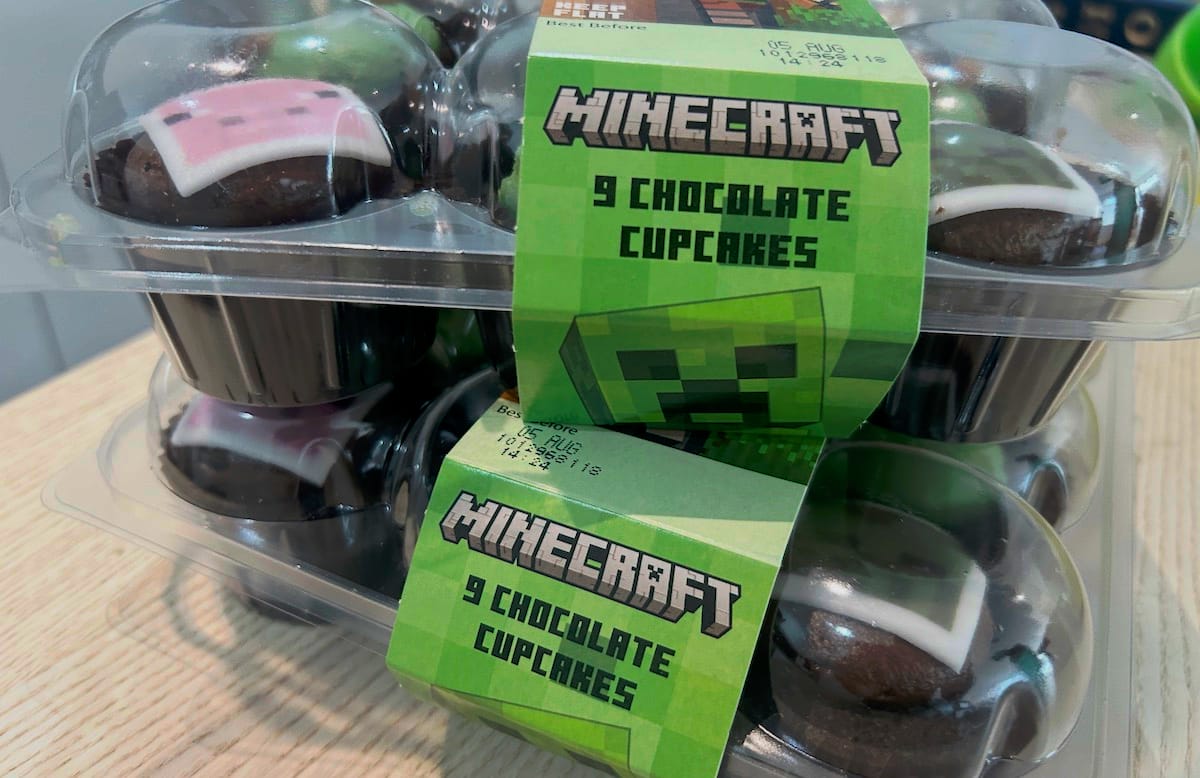
My son asked for Minecraft. He didn't really want Minecraft. He wanted the feeling of it, rendered in cupcakes.
Likely you've got something to make this week too. What could you get wrong on your own first, before you go looking up how it's done?
Howard
P.S. It’s also ok to buy some things from the supermarket. You didn’t really think I was going to bake two dozen Minecraft cupcakes, did you?
Extended Mix
- The coat of paint nearly got it banned. In 2024 the ratings board PEGI flipped Balatro from "3+" to adults-only overnight - "prominent gambling imagery" - and it was delisted across parts of the EU. There's no actual gambling in it; the poker is a skin. LocalThunk fought back, PEGI climbed down to "12," and even rewrote its gambling policy. The onboarding tool was that convincing.
- 48 to 208,401. That's what Balatro's Steam wishlist did between May 2023 and launch day. The first few hours of sales beat his entire lifetime earnings up to that point. He marked it with burgers and champagne.
- Minecraft started the same way - one person (Markus "Notch" Persson), messing about with blocks, no plan. Microsoft bought it five years later for $2.5 billion. My son's Block Party has a smaller budget.
- "The Balatro Timeline" - LocalThunk's own blog, honest about the anxiety attacks as well as the champagne.
Member discussion