Groove Theory #36 - Half-Time in Genoa
I'm your host, Howard Gray - founder of Wavetable.
Currently: launching a game where you play an AI shopping agent; writing about a venture capital firm's alternative to university.
One Sunday in April 1995, Channel 4's man in Italy was presenting the Genoa football derby live, with Elvis Costello beside him as the half-time guest. He read out the scores:
A striker at Bari had scored twice: his aim is certainly true.
An own goal for Milan: accidents will happen, as we know.
Lazio held goalless by Cagliari and their striker Luís Oliveira: having a bit of trouble against Oliver's Army.
Eight Costello song titles in one run of half-time scores, with the man who wrote them at his elbow.
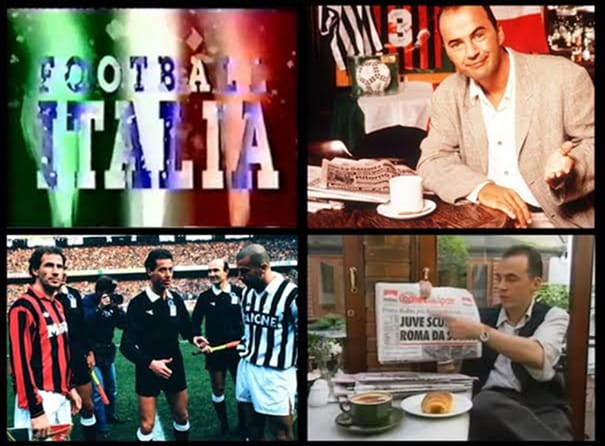
Most weeks he wasn't at a match at all. On Saturday mornings, on Gazzetta Football Italia, he sat at a café table in Rome with the Italian sports papers and an ice cream of real ambition, and read out the back pages.
The man was James Richardson, and nobody had hired him to be on television.
In 1992, British broadcaster Channel 4 bought the rights to Serie A football. The presenter was going to be Paul Gascoigne, England's most famous footballer, who had just signed for Lazio. What the show needed was someone in Rome to make sure Gazza actually got recorded: a producer, on a tiny budget, who spoke Italian.
Richardson was a producer at Sky. A friend of his worked at the production company, and she told him they were looking.
He didn't call them.
A week later they still hadn't found anyone, so he rang. He'd never worked in front of a camera, but he had Italian, and he'd learned it because of a girl from Rome. He got the job.
Three weeks in, he was standing on the lawn of Gascoigne's villa one Thursday evening, with material due in London and the light going. Gazza wasn't there. Gazza had mostly stopped being there. There was no money for a studio, and Channel 4's presence in Italy was, as Richardson puts it, "effectively just me." So he presented the segment himself, and assumed he'd be back in London in a couple of months.
The Tension
Channel 4 thought they were hiring a producer who spoke Italian. That was the spec. It was written down, anyone could check it, and Richardson could prove it.
What they got was a presenter, which he'd never been, and a man who can't leave a word alone. Hand him a list of football scores and he'll give it back full of puns, in his own language.
Nobody could have hired him for either. He couldn't show he could present, because he never had. And outside an ad agency, there's no line on a job description that reads "unusual facility with wordplay, please supply examples." The only way in was the Italian, and that was luck, a side effect of his love life.
Step Into It
Somebody picked you for the job you're doing now, off a list they could check without ever watching you work. The line that gets a stuck meeting laughing wasn't on it. Nor was renaming a project so people stop dreading it, or telling someone exactly what was good about their work. LinkedIn's skills section has no box for any of them.
Afterwards there's nothing to show anyone, only people saying it went better than they expected.
The Groove: Signal
Half-time scores are the most forgettable thing on television, and Richardson treated them as material. In Genoa, three years in, live, with Costello at his side, he took the most disposable minute of the broadcast and turned it into a set. The scores weren't precious, so he could play with them. The match belonged to the commentators, and the filler was left to him.
I watched him every Saturday morning as a kid. I even wrote about him once, in 2021, as a story about debuts, and never noticed what he'd been hired for.
"Chelsea paid a levy for the Shevy but the Shevy went dry." On Andriy Shevchenko's goals after his move to Chelsea.
"Like an Egyptian fish, he's living in denial."
"...as unsung as Posh Spice's back-catalogue."
"What's pink and floppy, but when I'm finished with it, red all over? The newspapers!"
And I can't resist a pun. It's less a skill than an urge, firmly at the dad-joke end of the market, and the people around me have put up with it for decades. Christmas gift tags? Cryptic puns. Mistype 'of course' in a text? Magny-Cours, coursing through my veins, par for the coarse. And on and on.
(What's So Funny)
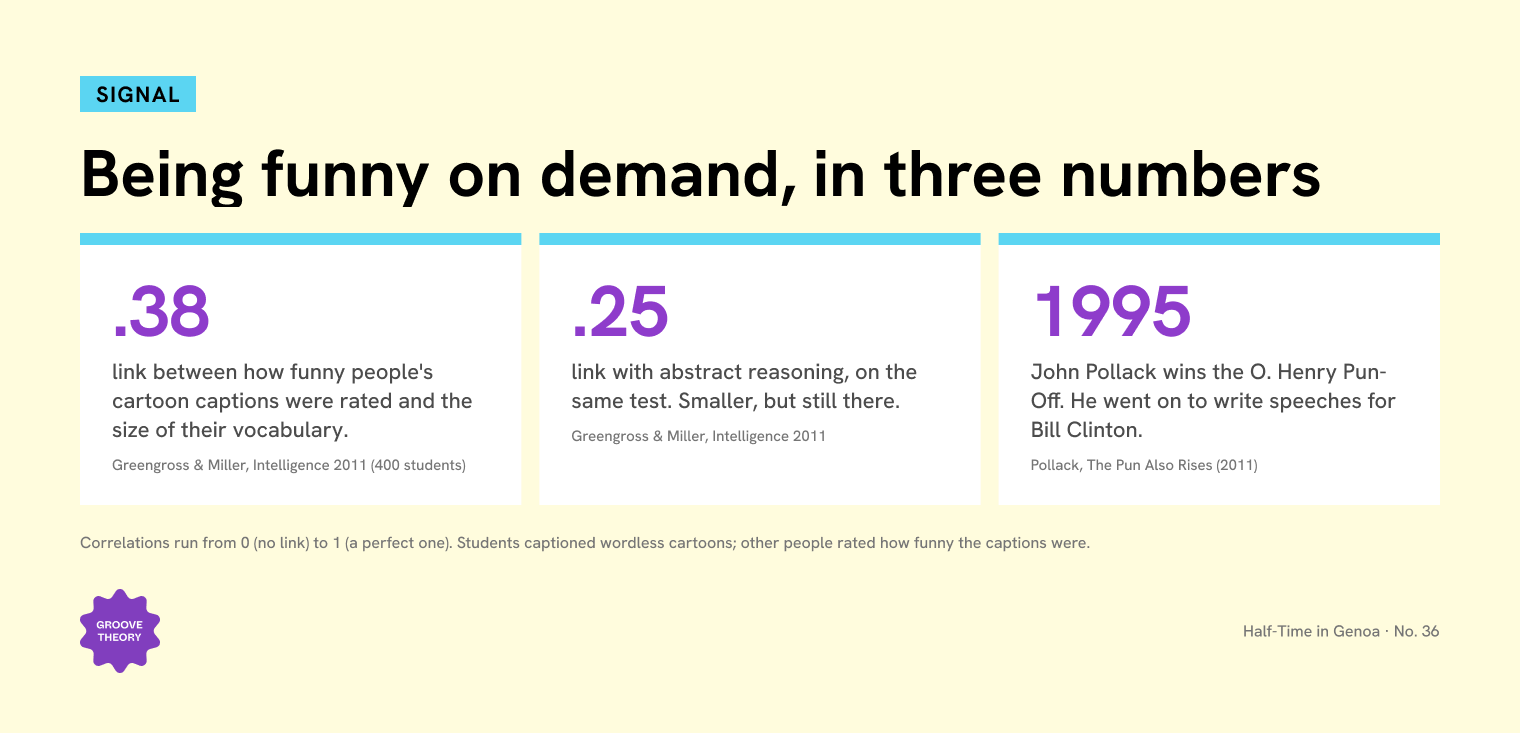
Puns are cheap, which is part of why they never make a list. Being funny on demand is a better test than it looks. Give 400 students some wordless cartoons to caption, as Gil Greengross and Geoffrey Miller did in 2011, and the ones other people found funniest tended to have the bigger vocabularies. A later study of 270 adults found a link to general intelligence, and to how fast people can pull words out of memory, which is most of what a pun is.
Every selection process screens for the visible skill. Richardson's wordplay wasn't on anyone's list. John Pollack's was.
Everyday I Write the Book
In 1995, the same year as the Costello afternoon, the young American journalist won the O. Henry Pun-Off World Championship in Austin, Texas. Four years later, by his own account, he was up for a speechwriting job in the Clinton White House, against a Pentagon speechwriter with more experience and better connections. The decision memo went to the president. Clinton circled World Pun Champion, wrote "good!" in the margin, and Pollack got the job.
Pollack has a theory about why puns get the groan. Irony and sarcasm take things apart, and a pun builds a link between two things. "It's always harder to create than it is to tear down."
Man Out of Time
Richardson's wordplay is closer to improv than stand-up: it's built out of whatever happened that weekend, so you can't reuse it. Some of it he writes in the minutes between the final whistle and going live.
After Messi scored against Mexico at the 2022 World Cup, he opened with: "My mum always used to tell me not to leave a messy room, and now Mexico know why." The rest arrives mid-conversation on the podcast, a wry line straight back at whoever's just spoken.
"When you're speaking," he says, "you can do what you want with words." Retold the next day, most of it is a you-had-to-be-there.
The messy room is in the first ten seconds.
1) The visible skill.
What a hiring bar can see and check: years, a degree, a language. Richardson's was Italian, learned for a girl in Rome. It got him the job, and the job turned out to need his English.
2) The dull bit.
Every job has a part nobody's watching, and anything good there stands out because no one expected much. Richardson's was the half-time scores. See Derek Sivers on CD packaging.
3) Borrow their words.
You can't put the invisible skill on a list yourself, but other people can name it for you. Next time someone sends work or an introduction your way, ask why they thought of you. It rarely matches how you'd describe yourself, and it's in words people trust more than yours. More in Why Me?
The Release
Yeah, you're right - Richardson got lucky. Right language, right week, nobody else available, and a friend on the inside. All true. And it doesn't explain why he's still on air thirty-four years later, mostly on football podcasts I listen to too often, frankly.
When people describe the show, they describe a man at a table with a ridiculous ice cream, reading out the Italian back pages, finding a joke in a transfer rumour.
None of that was the plan. The plan was Gascoigne, and Gascoigne kept not turning up.
Most projects have a Gascoigne in them, the bit everyone's counting on. Sooner or later it falls through. That's when the things nobody hired you for get their chance.
Howard
P.S. The subheads in the Groove section all come off Costello records. I'd love to tell you I knew them by heart. I had to look them up.
Extended Mix
- I wrote about this once before, in Adventures #54, back in 2021. The archive is now public if you want the earlier version of me missing the point.
- The pun champion. Pollack tells the Clinton story in this interview and makes the full case in The Pun Also Rises (2011), which argues the alphabet could not have been invented without puns. Bold, and I'm on his side.
- The Costello afternoon, in full. Five minutes. The other five titles are in there, and at the end he tells Costello he's a man out of time.
- Out loud. Puns are made for talking, and Richardson ended up in podcasts. Tyler Cowen thinks "we are continuing to move from a literary culture to an oral culture" (The Free Press, December 2025), which would make the wordplay worth more, not less.

Member discussion